Biscuit

Etymology Post: Biscuit

The word biscuit is just so weird I had to research it. Also, my cousins have a dog named Biscuit. Hi Biscuit! Hi cousins!

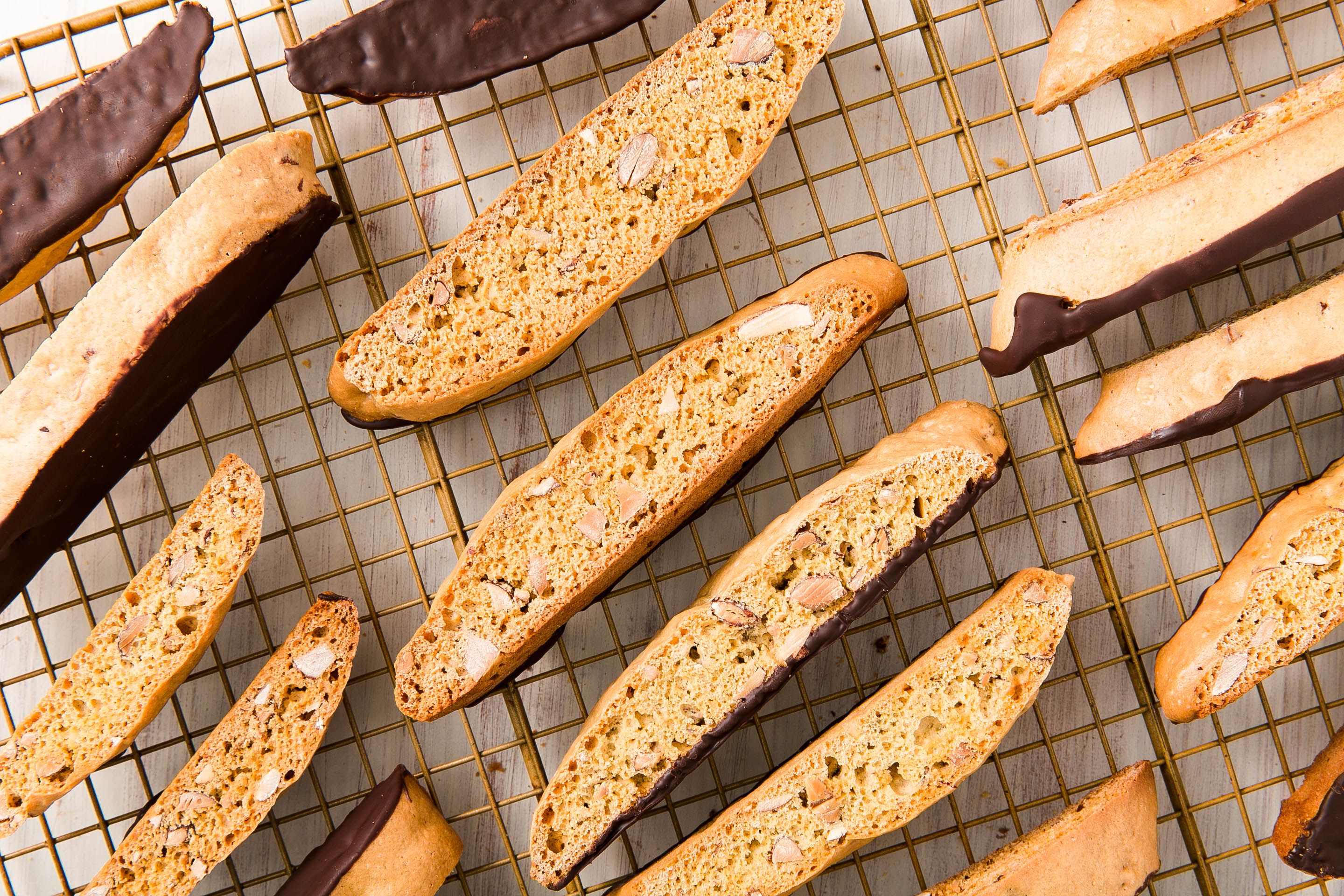
The word is made up of two word-forming bits: bis from Latin, meaning “twice,” and coctus meaning “cooked.” The word was originally panis bis coctus, meaning “bread twice-cooked,” and was shortened to biscotum, and then eventually biscotto. Then French got ahold of it and suddenly it was bescuit because French can’t help but throw an errant i or e into everything. Then English was like, “we’re mostly illiterate so we’re gonna call this a bisket cuz that’s what it sounds like you weird Frenchies are saying.” And, as most people know, it’s really definitely only used to refer to harder bread products that we would call cookies here in the states.

Traditional biscotti is a twice baked sweet bread, and though most cookies are not twice baked, the texture is similar so it’s understandable why the English would start calling them biscuits.
Best Biscotti Recipe - How To Make Biscotti


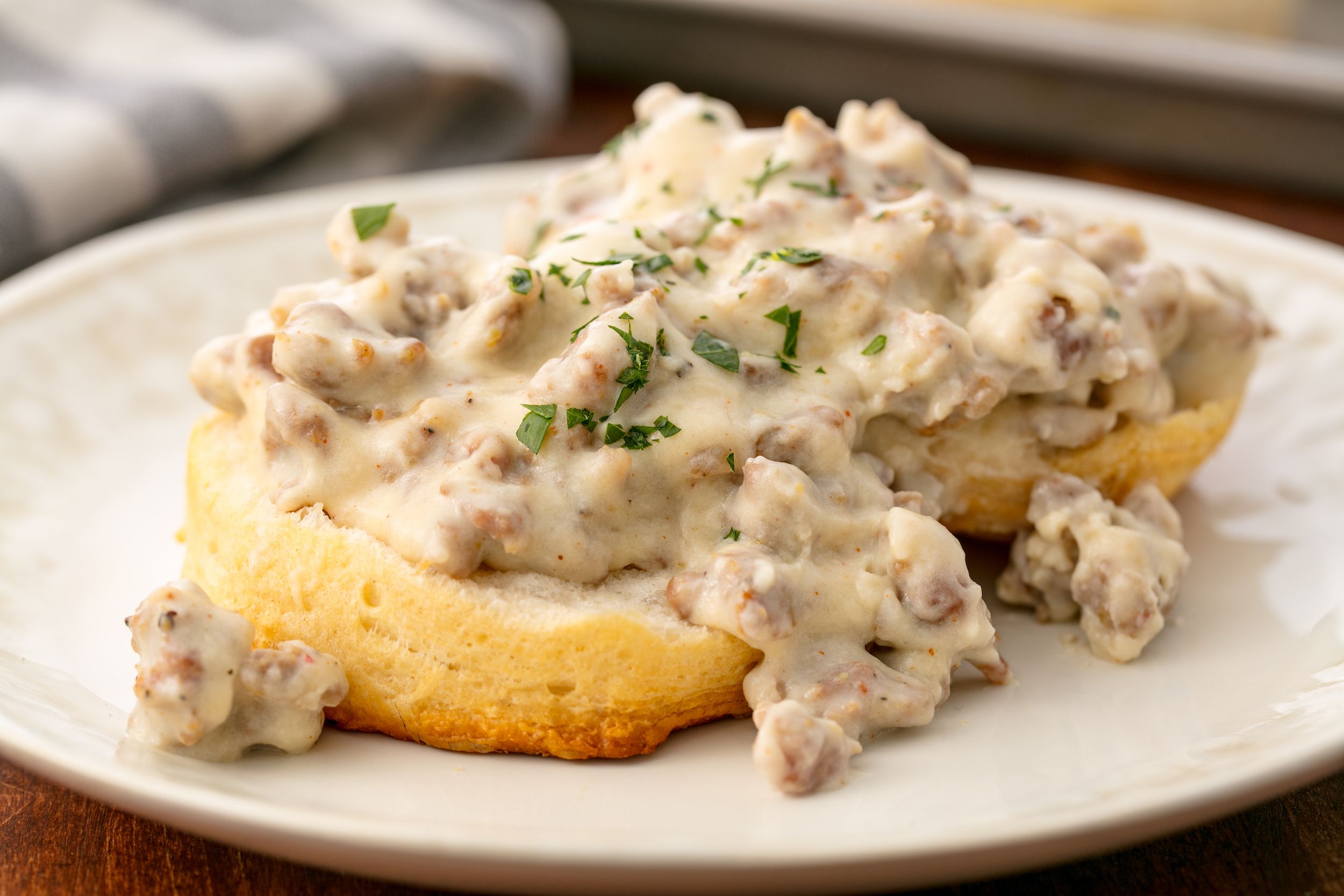
The first use of biscuit being used to for those awesome things you get with gravy in the south, was recorded in 1818 to describe the sort of food that sawmill workers were being served in Appalachia at the time. Those biscuits were probably pretty stodgy because baking powder and soda hadn’t been invented yet, so to give them some leavening they (meaning a kitchen slave) just beat the crap out of the dough until slavery was abolished and then a machine was invented to do it. These were served with gravy because pork fat was abundant and cheap. These biscuits were sort of a more nutritious and filling form of hardtack because they had lard added (fats are filling). The thinking around calling them biscuits is that it came with the Scottish colonists who settled in Appalachia. They called them “soft biscuits” in Scotland, and the name, much like biscuits and gravy, stuck.
Easy Homemade Sausage Gravy Recipe - How to Make Best Sausage Gravy
Oops, now I’m hungry.


Here’s a WAPO article about the origins of the southern biscuit: https://www.washingtonpost.com/news/voraciously/wp/2019/07/22/today-even-fancy-restaurants-serve-biscuits-and-gravy-but-the-dish-comes-from-modest-beginnings

Professor Plum in the Conservatory With the Lead Pipe

My sister’s Instagram friend lives in the UK and he mentioned that, when visiting his brother, rather than staying in the main house, he slums it in the conservatory. Upon hearing this, my sister exclaimed, “Your brother has a CONSERVATORY!?!?” because here in The States, having such a thing makes one sound quite posh. This got me thinking about the different forms of this type of structure, and all the different words for them which vary by region and use.

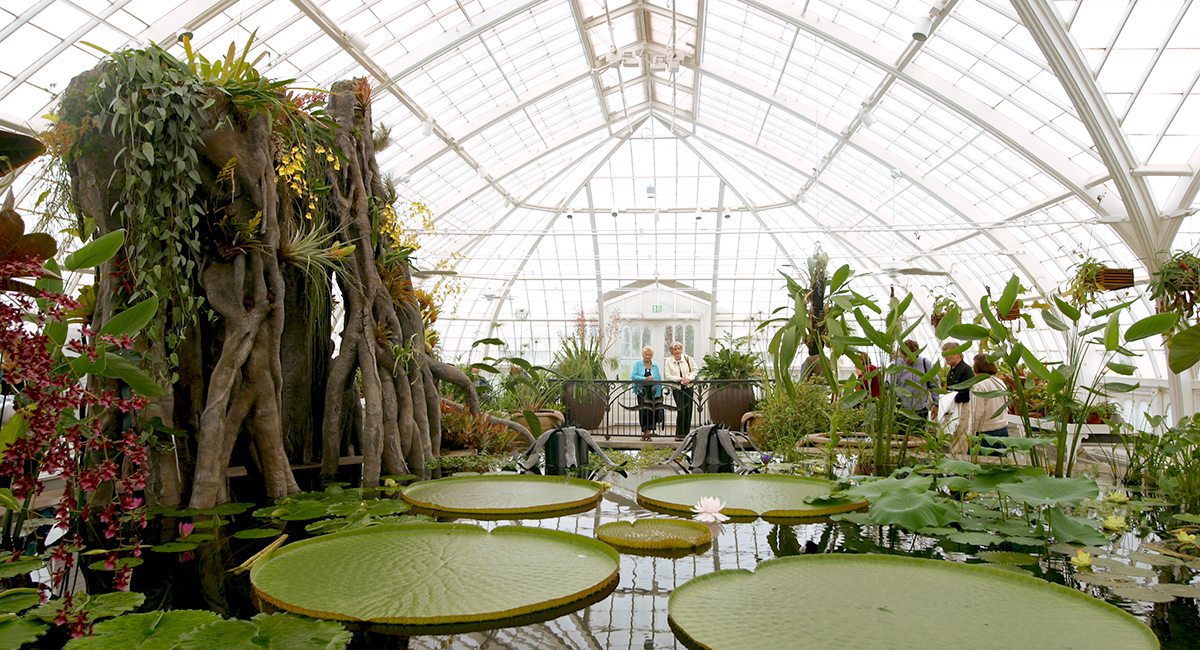
When one says The Conservatory, it calls to mind visions of a glass room off the side of an old victorian mansion filled with gigantic tropical plans and a fainting couch, but apparently it’s just what we in the States would call a sunroom, or in New England, a three-season porch.

7 Bartlett Street, Somerville MA Real Estate Listing | MLS# 72224497
Classic Three Season Porch on the second floor of this house in Somerville, MA.

The classic three-season porch is a semi enclosed porch, usually off the back of each floor of a triple-decker apartment building. It’s usually got wood framed, generally uninsulated, solid walls which turn into window frames about halfway up which usually have both screens and glass storm windows. It’s so-named because in New England we have cold winters, so you can usually get about 3 seasons of use out of it. Lots of folks just use these as storage, or a place to hang your laundry to dry. You do sometimes see them on houses, but often these are more widely referred to as screened-in porch, or just screened porch. In Hawaii this is known as a lanai, or in Arizona and other parts of the southwest, the arizona room. There’s also the breezeway, which is a long, generally open-walled but always roofed structure which connects two structures.

Incidentally, the triple-decker is considered to have originated in Massachusetts and hundreds of thousands of them were built in and around New England between 1870 and 1920, particularly in rapidly industrializing areas where lots of people were working in mills and factories and needed housing.

Anatomy of a Three-Decker (or Triple-Decker, If You Prefer)

We also have something called a sunroom, which more closely resembles the classic idea of a conservatory or solarium in that it generally has large windows or a wall of windows, and often has a tiled floor. In the UK in order for a structure to be designated a conservatory it has to have “at least 50% of its side wall area glazed and at least 75% of its roof glazed with translucent materials, either polycarbonate sheeting or glass1.” The custom of conservatories dates back to Roman times when folks would bring their tender citrus plants inside during cold spells and place them into rooms called limonaia. In northern Europe, they were known as orangeries, and from there evolved into conservatories, so named because of their practical use for conserving plant life which would otherwise perish in the cold. Many of the beautiful, large and ornate Victorian era conservatories still exist in Europe and across the US as well. Some classic examples include the Conservatory of Flowers in San Francisco, CA and the Glasgow Botanical Garden in Scotland.

Lipstick, Fanged Pitcher, Flying Goldfish, Cobra, Lillipop…Say What?! | MIG

The habit of having a simple conservatory on one’s house came into fashion in the 1950s after more advanced glazing techniques were invented.

Weirdly, I actually have had a lot of conversations about what the actual definition of a porch is, vs a balcony or veranda. In our old apartment, which was a triple-decker, we had a back porch (which I miss very much), but it was on the second floor, and I’m not quite sure that counts as a porch or a balcony. It wasn’t screened in and had no windows. It wasn’t technically a veranda because those are always placed on the ground floor. I always went with back porch, but never really felt satisfied with the use of the word.

The word porch comes to English from Old French porche which got it from Latin porticus which specifically referred to a covered walk between columns, and itself was formed from an older word porta, meaning “gate, door, entrance.” Porta is likely from the PIE root *per- meaning “to lead or pass over.”

That etymology unfortunately doesn’t help me with my quest to find a better word for the structure that we so enjoyed at our old apartment, but I’m glad to have had the time to research it anyhow.

Got an unusual form of porch, conservatory, or sunroom where you’re from? Share in the comments below.

1 Source: https://en.wikipedia.org/wiki/Conservatory_(greenhouse)

No

Etymology: No

Nope GIF - Nope Duck NoWay - Discover & Share GIFs | Funny gif, Funny  pictures, Animals

Every language has a word for it. Some have many. Let’s explore the etymology of no.

In English the word no dates back to Middle English and means “not in any degree, not at all, not ever.” Though it’s a short word with only two letters, it’s actually formed from two elements, the first being the PIE (proto indo european) root *ne- meaning “not,” and the second from the PIE root *aiw-, meaning “vital force, life, long life, eternity.” In fact, the root *aiw- is where we get the word ever from, as well as the words eon, eternal, age, and the Old Norse word ævi, meaning “lifetime.” Thus the word no literally means, “not ever.” I love this etymology because it shows the powerful refusal that no implies. It says, “not now, not ever, not for my entire life, not for all eternity.”

Another formally popular refusal word in English is nay, which comes to English from the Old Norse word nei, but Old Norse got nei from the same PIE roots as no, so they’re basically the same word but nay sounds more like the original pronunciation.

Many other languages use a similar sounding word to say “no” and those words all have the same etymology. In French it’s, non. In Italian, Spanish, and Nepalese, no. In Portuguese, nāo. In Russian and Serbian, net. In Polish, nie. In German, nein. In Bosnian, Croatian, Czech, and Latvian, it’s ne. In Ukranian, ni. In Danish and Swedish, nej. In Icelandic and Norwegian, nei. In Persian, næh. In Hindi, nahin. In Punjabi, nahīṁ. In Bengali, . In Latin, nihil. In Irish, níl.

Then Greek comes along and is like, how about we make our word for “yes” be nai just to confuse the rest of Europe! Their word for “no” is ochi, which actually has the same PIE root *ne- that no uses, but rather than combining it with *aiw-, it was combined with *ko which is a root that’s used to form words having to do with pointing out things, for example, who, what, him, her, that sort of thing.

In the Maori language, the word for “no” is kāo, or kāore. This word is also used when making grand statements about things, for example, “How great is my anger!”

In Welsh, the word is either ni, nid (for vowels) or dim, and it is entirely context related which one is used. It’s one of those “fun” linguistic curiosities where you really have to be a native speaker to understand when to use dim vs ni/nid and using one instead of the other would sound really weird, but it’s tough to explain why to a non-native speaker. In Middle Welsh, dim meant “anything,” but it became common to use it to reinforce negative statements like, “she was anything but frail.” So it wound up as an additional way to say “no.”

When did you last use the powerful word NO in your life? Did it make you feel empowered or did it make you feel bad? How do you say “no” in the languages you speak? I’d love to learn more about the etymology of words in more non-European languages. It’s often a challenge to investigate etymology in languages I’m not familiar with. Translations are possible, but diving into the construction and history of words isn’t easy for a non-native speaker. My curious mind often calls me to try though!

I Just Don’t Like Them

A friend of mine posted this image of what’s described as “Some of the best words literally ever”:

Because I’m apparently a word snob as well as being a word nerd, I chimed in that most of these words really rub me the wrong way. I’ll explain why.

Aside from shenanigans, brouhaha, kerfuffle & skedaddle, all of the words in the image above contain other words or sounds that I find displeasing. For example, I’m not a fan of the words pump, poop, come, gag, pus, gas, bob, booze. I don’t like the way they sound, I don’t like the shape my mouth and tongue make when I speak them, I don’t like the meanings or associations they have, and I really don’t like how most of those words sound when spoken in the accents I grew up listening to.

I also really detest words that have a sing-song style of delivery, which I realize is super weird because I love Scandinavian languages which lots of people describe as being sing-songy. A lot of my friends will be upset with me for saying so, but the English speaking tendency toward making up words like the above just annoys me. In fact, I’d wager that most of the words above are nonsense words that came into fashion from English slang. Let’s find out.

Bamboozle is from 1703, slang origin.

Flabbergast is from 1772, a vogue word that’s likely a combination of flabby and aghast.

Discombobulate is from 1834, and is an American English mock-Latin coinage.

Catawampus is from 1834, and is American Slang.

Lollygag is from 1862 and is an American Slang combination of a dialect slang term for “tongue”, ie: lolly, and gag, meaning “trick or deceive.” It’s also sometimes spelled lallygag.

Malarkey is from 1924 and is American English and probably a slight toward Irish people.

Nincompoop is from the 1670s and is probably French and probably a proper name and thus is pretty mean.

Pumpernickle is from 1756, German, and originally an abusive nickname for a person of low intelligence. It’s the combination of the words pumpern which means “to fart” and nickle which means “goblin, lout, or rascal.”

As you can see, most of these words are just nonsense words or actually kind of mean words. Now on to the words I actually like:

Shenanigan is from 1855, it’s Californian, and thought to maybe have come from the Spanish word chanada or charranada which means “trick or deceit.”

Brouhaha is from 1890, is French, and of debatable origin though most people think its onomatopoeic since it sounds like what it means.

Kerfuffle is from an old Scottish word that’s a combination of the word car, meaning “bend or twist,” and fuffle, meaning “to throw into disorder.”

Skedaddle is from 1861 and is American Civil War military slang and its exact origin is unknown.

New Category Announcement!

Neology

My dear friend Jeremy made a suggestion to me recently to create a new category for my blog wherein I challenge myself, or let others challenge me, to come up with new words based on a need for words that are missing from the English language. He called this practice theorycrafting, which I LOVE, and which is the mathematical analysis of game mechanics, which one usually employs to discover optimal strategies and tactics.  In this case, I’m going to take the query someone puts to me, and see if I can use what I’ve learned about the way English words have historically been formed to create a new word. I will name my new blog category Neology, which means “the coining of new words.”

A neologism is any new term, word, or phrase that rises up, generally within a subculture, to more widespread use, but hasn’t quite been adopted into mainstream language yet.  Sometimes these words make it into the dictionary, sometimes they don’t. I’m not expecting that any of the words I create here will ever be neologisms, or make it into Mirriam-Webster, but one never knows!

Some of you may have already learned that in Iceland they practice linguistic purism, which basically means that when the need for a new word arises rather than using a foreign language word as a cognate, the folks at the Icelandic Language Institute and others work to create a new word which adheres to the rules of the Icelandic language. They will often combine old words, or find words that philosophically or metaphorically provide a good description of whatever the new word describes. For example, when the time came for Iceland to invent a word for “computer,” they created the word tölva, which is a combination of the Icelandic words tala, meaning, “number,” and völva, meaning, “witch, prophetess.”  Thus tölva is essentially means “number witch.”

With that in mind, this will be my attempt at word creation using the linguistic “rules” of English.  (I put rules in quotation marks, because let’s face it, English barely makes sense.) I’m going to try the Icelandic approach and use parts of words that already exist and combine them.

My First Word

Jeremy asked me to come up for a word that means “to feel more love for someone in response to a situation unrelated to the object of your affection.”  For example, when you observe a couple doing something that you think is really lame or gross or otherwise offensive to you personally, you feel more love for your partner because you know they’d share your offense and never ever do whatever thing is offending.

My word is, offendaffected, a verb meaning “to feel more love for someone in response to the observation of an offensive act unrelated to the object of your affection.” Pronouned: off – fend – aff – eckted  “It offendaffected me earlier at the cookout when Joyce criticized the way her husband cooks his burgers in front of everyone.  Thanks for always being gentle when you give me feedback about my cooking.”

Noun form: offendaffection. “I always have offendaffection for my own kid when I see other kids being terrible.”

Adjective form: offendaffectionate.  “I feel so offendaffectionate toward you, my love, upon observing that couple holding hands on a very hot humid day.”

Other uses:

“It always offendaffects me when I see dogs being horrible at the dog park and I think about how my dog is the GOODEST BOI.”

“It was so offendaffecting when I saw that Sue and Barb were wearing matching NASCAR t-shirts the other day.”

My notes:

I decided to combine the words offend and affection, and put offend first since the action I’m trying to describe is inspired by an offending act which then causes affection. This was tricky because I kept getting tied up in that anxiety I always seem to feel about affect vs effect and affected vs effected no matter how often I review their proper uses. This wasn’t a problem with the noun form, but the verb got tricky, plus there are so many verb tenses. Jeremy did ask for a verb, which also made this tricky because feelings are often used as nouns not verbs, so I had to really think about how this term would be used and how to make the verb, noun and adjective forms. I also went back and forth between offendaffected and offensaffected because both seemed better for different uses, but I landed on offendaffected.

Let me know what you think about my word, and hit me up with any suggestions for new word creations.

Centenarian

Etymology: centenarian

Today, my dear sweet grandma is 100 years old!  Although I credit my grandfather for my love of words, anything that’s practical, skillful, witty or quietly nourishing about me I owe to my amazing grandma Betty.  Due to quarantine rules, we are unable to celebrate this momentous day with her in person, so we’ll settle for a family Zoom video call. She’s currently dealing with a positive diagnosis for COVID-19, but is blessedly asymptomatic and her doctors are optimistic that she will stay that way. Still, we welcome any good thoughts to be sent her way!

95608247_10156902560182085_3750188335595782144_n

Though she will likely shy away from any acknowledgement of this achievement in her usual mildly self-deprecating way, it’s obviously quite a big deal to those of us who love her. She is now a centenarian! Has a nice distinguished ring to it doesn’t it?  The first recorded use of the word was in 1805.  Prior to that, people used the word centenary either as an adjective to describe things related to or consisting of 100 years, or as a noun to describe a period of 100 years or the celebration of a hundredth anniversary.  This word is still used in British English, but in America we tend to use the word centennial.

Both centenary and centenarian come from Latin centenarius, which formed from the word centum, meaning “hundred.”

As an aside, the English word hundred comes from a Proto-Germanic word, *hundam.  The Proto Indo European root for both centum and hundam is the word, *dekm-, which actually means 10.  This PIE root gives us a clue as to how the somewhat different sounding words centum and hundam happened. There’s this thing in spoken language where consonant sounds evolve over time, often due to people skipping or combining sounds to speed up speech. There are lots of different ways and reasons why this happens.  (Here’s a good wikipedia article about it for those interested.) Basically people added some suffixes to *dekm- to multiply it for use as the number 100.  Latin ended up with the one that sounded more like satam or centum, and Proto-Germanic ended up with the one that sounded more like hundam.  Language is weird.

Anyhow, I’m happy to be celebrating my favorite centenarian today. 100 years of Betty is never really enough, but I’ll take it. Here’s to 100 more!

Limbo vs Liminal

My friend Rick Webb tagged me in a Facebook post asking for some clarification on whether the words limbo and liminal are related, and if so, are they related to the point of being synonymous which would make a sentence like “In permanent, liminal, limbo.” kind of bad English.

Here’s my explanation of why it isn’t the worst English, but also kind of is bad English, but how that isn’t really Rick’s fault and we probably have 13th century scribes to blame.

Screen Shot 2020-04-24 at 11.21.14 AM

Ok here we go! Limbo comes to us from latin, limbus, meaning “edge, border, hem, fringe,” HOWEVER! There is some debate as to whether the word limbus originated in Latin, because it isn’t a particularly old Latin word comparatively.

The idea of Limbo as being a waiting place on the border of Hell was actually sort of a mistake made by English speakers way back in the 13th century. Basically the Latin word limbo is the ablative singular of limbus, so it would be used in latin phrases like “in limbo patrum” and English readers would say, “Oh that must mean literally IN limbo” and made Limbo into kind of a noun/name, but it really wasn’t correct. Correct latin would be “limbus patrum” which literally means an edge or border (of Hell) reserved for pre-Christian saints.

The word came into fashion as generally “a place of confinement, oblivion or neglect” in the 1640s.

Also just as an aside, the limbo DANCE has nothing to do with the limbo described above, and is simply West Indian alteration of the word limber.  Limber probably comes from the word limb (in its definition as a bodily extremity), which is actually of proto Germanic origin (see the root word *limu-), but it got mixed up with the latin word limb meaning “edge” and the b was added, since people didn’t really have spell check back then and English was already getting confusing. 

So let’s move on to liminal. Liminal is one of my very favorite words in any language so this is very fun for me, fyi.  Liminal is an adjective, not a noun so that already sets it apart from limbo, and it comes from the Latin limen, which rather than meaning “edge or border” means “threshold” and though the idea of an edge or border and the idea of a threshold seem really similar to each other, they really aren’t once you dig into it. 

Liminal spaces like thresholds are in-between spaces, and their sole purpose is as a space where things pass through and don’t remain. Airports are liminal spaces. The side of the highway is a liminal space. City parks are liminal spaces. Grand Central Station is a liminal space. The breaking of dawn and the setting of the sun are both liminal spaces.  I LOVE liminal spaces. They are full of magic and weird energy because so many people trod through them but no one ever stays unless something’s gone very wrong. 

BDgBYzF32hJSyeayqyvfBj

So you can see how this word is very different from limbo, which means stuck or halted and unable to pass through. So even though they look the same, they really aren’t as related as one might think, but it’s totally reasonable to assume that at one point in time they both sort of came from the same arm of whatever proto language the sound “lim” formed in. 

As another aside, my Somervillian Chinese uncle Jimmy’s last name is Lim, which in Chinese literally means “woods or forest,” as does the maiden name, Dubois, of his wife, my aunt Meg. The forest is truly one of my favorite of all liminal spaces, since most people pass through a forest, though some people do live there if they can.


Fever

Etymology: fever

hqdefault

This word comes from Old English fefor, or fefer, which is from the Latin febris and is related to another Latin word fovere meaning “to warm, or heat.”  There is some debate on the origin of febris or foever.  Some linguists think it’s from the PIE root dhegh-, meaning “burn.”  Others speculate it comes from an old Sanskrit word element bhur-, meaning “to be restless.”

Plague

Etymology: plague

blackdeath_main

From Old French plage, via Latin plaga meaning “wound,” and plangere, meaning, “to strike, or lament.”  Or from the Greek, plaga, meaning, “blow,” as in a hit or strike.  All of these words come from the PIE root plak- (2), meaning “to strike.”  You’ll find this root in words like plankton, complain, and apoplexy.  The word plague came into use in English in the 1540s as a term for a pestilence with many casualties after the bubonic plague began to scourge Europe.

Vaccine

Etymology: vaccine

Edward Jenner[3604]

Believe it or not, this word actually relates to cows!  Don’t worry, I’ll explain.  The Latin name for the cowpox virus is variolae vaccinae, which comes from Latin, vaccinus, meaning, “from or pertaining to cows.”  The word vacca, in Latin, means “cow” and no one is sure of its origin.  Incidentally, the English word cow is a very old word dating back to the PIE root gwou- and is pretty much the same in all Germanic languages.  Anyway back to vaccine!  Smallpox was a very big problem for humans prior to around 1800.  It was observed that milkmaids, due to having been exposed to a similar but much less deadly infection called cowpox, had developed an immunity to smallpox. British physician Edward Jenner accidentally invented the vaccine by injecting people with the cowpox virus, or vaccinae, making them immune to smallpox as well.

The word wasn’t used in reference to other diseases until Louis Pasteur, inventor of the rabies vaccine, started doing so.  Incidentally, Pasteur also invented pasteurization, and thus the word pasteurize is simply Pasteur’s surname with -ize added to it.  His surname is French and means, “pastor.”

Speaking of Louis Pasteur, when I was a kid, I remember seeing a video, or maybe it was just a book, where Louis Pasteur is explaining what a vaccine is to a young boy.  I remember he said that it’s like a bunch of soldiers are marching into your body to protect you from diseases.  I have been unable to track down this book or video, so if anyone else remembers this and can shed some light on it, that’d be awesome!