The word biscuit is just so weird I had to research it. Also, my cousins have a dog named Biscuit. Hi Biscuit! Hi cousins!
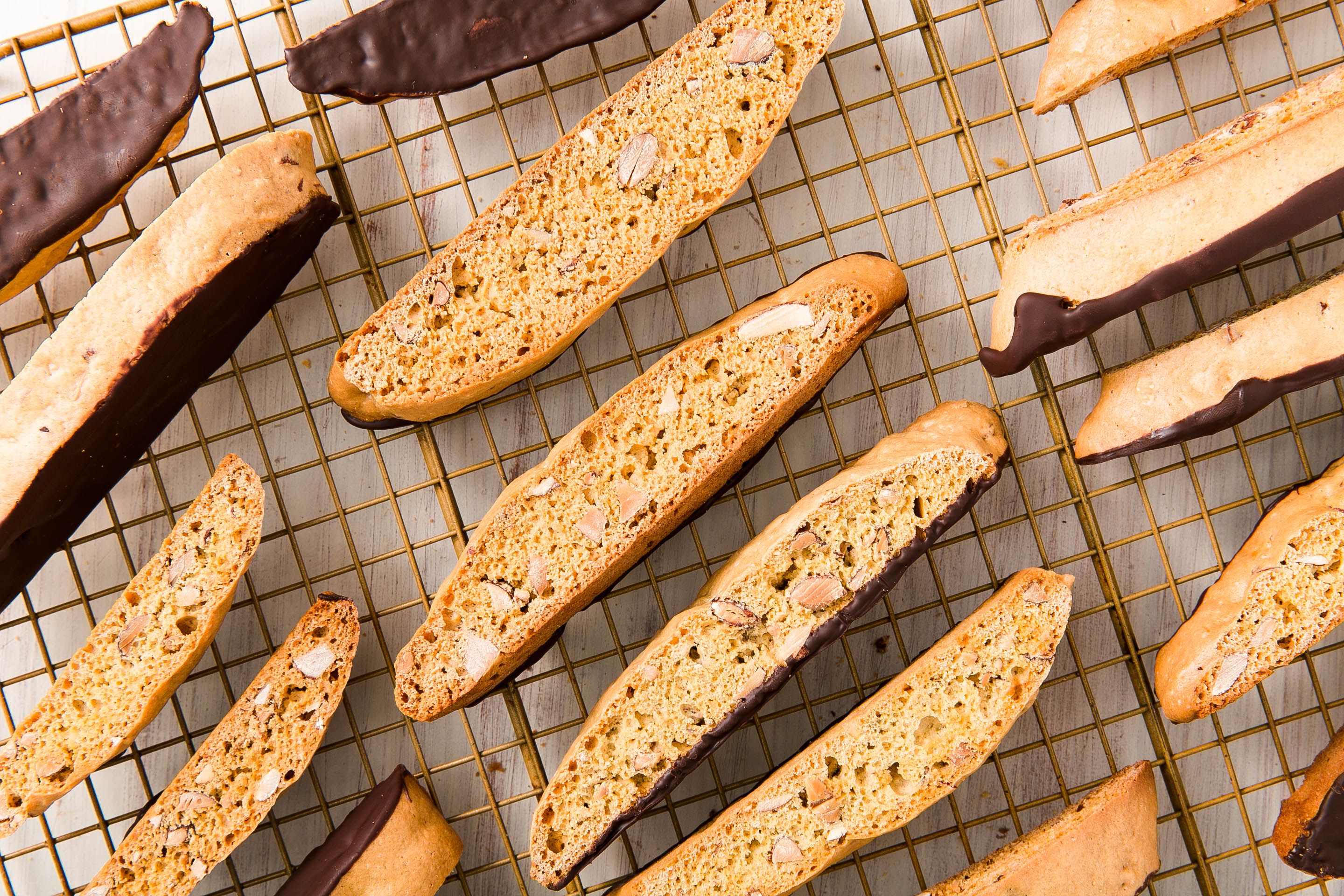
The word is made up of two word-forming bits: bis from Latin, meaning “twice,” and coctus meaning “cooked.” The word was originally panis bis coctus, meaning “bread twice-cooked,” and was shortened to biscotum, and then eventually biscotto. Then French got ahold of it and suddenly it was bescuit because French can’t help but throw an errant i or e into everything. Then English was like, “we’re mostly illiterate so we’re gonna call this a bisket cuz that’s what it sounds like you weird Frenchies are saying.” And, as most people know, it’s really definitely only used to refer to harder bread products that we would call cookies here in the states.
Traditional biscotti is a twice baked sweet bread, and though most cookies are not twice baked, the texture is similar so it’s understandable why the English would start calling them biscuits.
The first use of biscuit being used to for those awesome things you get with gravy in the south, was recorded in 1818 to describe the sort of food that sawmill workers were being served in Appalachia at the time. Those biscuits were probably pretty stodgy because baking powder and soda hadn’t been invented yet, so to give them some leavening they (meaning a kitchen slave) just beat the crap out of the dough until slavery was abolished and then a machine was invented to do it. These were served with gravy because pork fat was abundant and cheap. These biscuits were sort of a more nutritious and filling form of hardtack because they had lard added (fats are filling). The thinking around calling them biscuits is that it came with the Scottish colonists who settled in Appalachia. They called them “soft biscuits” in Scotland, and the name, much like biscuits and gravy, stuck.
My sister’s Instagram friend lives in the UK and he mentioned that, when visiting his brother, rather than staying in the main house, he slums it in the conservatory. Upon hearing this, my sister exclaimed, “Your brother has a CONSERVATORY!?!?” because here in The States, having such a thing makes one sound quite posh. This got me thinking about the different forms of this type of structure, and all the different words for them which vary by region and use.
When one says The Conservatory, it calls to mind visions of a glass room off the side of an old victorian mansion filled with gigantic tropical plans and a fainting couch, but apparently it’s just what we in the States would call a sunroom, or in New England, a three-season porch.
Classic Three Season Porch on the second floor of this house in Somerville, MA.
The classic three-season porch is a semi enclosed porch, usually off the back of each floor of a triple-decker apartment building. It’s usually got wood framed, generally uninsulated, solid walls which turn into window frames about halfway up which usually have both screens and glass storm windows. It’s so-named because in New England we have cold winters, so you can usually get about 3 seasons of use out of it. Lots of folks just use these as storage, or a place to hang your laundry to dry. You do sometimes see them on houses, but often these are more widely referred to as screened-in porch, or just screened porch. In Hawaii this is known as a lanai, or in Arizona and other parts of the southwest, the arizona room. There’s also the breezeway, which is a long, generally open-walled but always roofed structure which connects two structures.
Incidentally, the triple-decker is considered to have originated in Massachusetts and hundreds of thousands of them were built in and around New England between 1870 and 1920, particularly in rapidly industrializing areas where lots of people were working in mills and factories and needed housing.
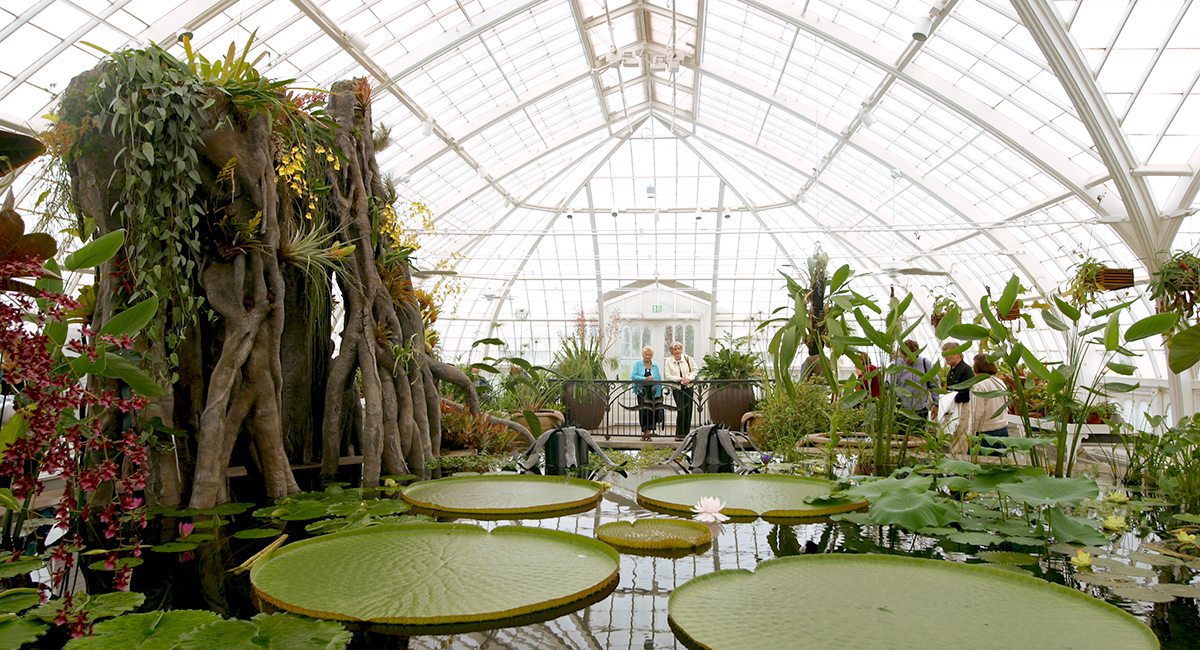
We also have something called a sunroom, which more closely resembles the classic idea of a conservatory or solarium in that it generally has large windows or a wall of windows, and often has a tiled floor. In the UK in order for a structure to be designated a conservatory it has to have “at least 50% of its side wall area glazed and at least 75% of its roof glazed with translucent materials, either polycarbonate sheeting or glass1.” The custom of conservatories dates back to Roman times when folks would bring their tender citrus plants inside during cold spells and place them into rooms called limonaia. In northern Europe, they were known as orangeries, and from there evolved into conservatories, so named because of their practical use for conserving plant life which would otherwise perish in the cold. Many of the beautiful, large and ornate Victorian era conservatories still exist in Europe and across the US as well. Some classic examples include the Conservatory of Flowers in San Francisco, CA and the Glasgow Botanical Garden in Scotland.
The habit of having a simple conservatory on one’s house came into fashion in the 1950s after more advanced glazing techniques were invented.
Weirdly, I actually have had a lot of conversations about what the actual definition of a porch is, vs a balcony or veranda. In our old apartment, which was a triple-decker, we had a back porch (which I miss very much), but it was on the second floor, and I’m not quite sure that counts as a porch or a balcony. It wasn’t screened in and had no windows. It wasn’t technically a veranda because those are always placed on the ground floor. I always went with back porch, but never really felt satisfied with the use of the word.
The word porch comes to English from Old French porche which got it from Latin porticus which specifically referred to a covered walk between columns, and itself was formed from an older word porta, meaning “gate, door, entrance.” Porta is likely from the PIE root *per- meaning “to lead or pass over.”
That etymology unfortunately doesn’t help me with my quest to find a better word for the structure that we so enjoyed at our old apartment, but I’m glad to have had the time to research it anyhow.
Got an unusual form of porch, conservatory, or sunroom where you’re from? Share in the comments below.
In an email, my wonderful pal Ashley used the word sublime. It was the best word she could think of to describe the feeling she felt when they put her son on her chest after she gave birth to him. I think it’s the perfect word for that experience and here’s why.
Let us start by separating the word into its two parts, the prefix sub-, from the Latin preposition of the same name, meaning “under, beneath, at the foot of,” and also “up to, towards, within, and during.”
Next, -lime, from Latin, limen, meaning “threshold, edge, limit, boundary.” Also the source of the word liminal. So the word sublime literally means, “at the foot of the threshold,” or “beneath the edge.”
I can’t think of a better word to describe those precious and rare moments in life where you are in a space of perfect presence with something hugely important. Before that moment was struggle, pain, and effort, and you know that on the other side of that moment is responsibility, the mundane, and everything else, so you stay with it as long as you can. The sublime.
The other day I was thinking about the word creature and that got me thinking about the word creator, so here is an etymology lesson for those.
Both words have the same PIE root, in Shipley’s it’s ker-(VI), which itself means “to grow,” and informs words like, crescent, increase, procreate, recruit, and accrue, and the name of the Roman goddess of agriculture, Ceres. (pictured)
Side note: my dear friend Sarah named one of her feline companions Ceres, only to find out later that Ceres was a boy, (R.I.P. Ceres! You were a big fluffy dummy and we miss you!)
For creator, ker-(VI) combines with the latin suffix -ator, which is basically the noun form of a verb that ends in -ate, in this case, create. (I think? Latin suffixes perplex me, so maybe someone who has studied Latin can school me?) So, creator means “one who causes things to grow,” and creature means, “a thing that has been grown.”
The PIE ker- root variations are pretty vast, Shipley’s has seven distinct ones, with meanings like, “to turn,” “to burn,” “to scratch or cut,” “of or related to having horns,” “to cry out,” “to grow,” and “to destroy.” It reminds me that PIE is at best a well-researched theory, but I suppose everything is.
The etymology of atonement comes from the Latin adunare. Ad, meaning, “to or at,” and unum, meaning, “one,” or in other words, the roots of the word atone mean, “united.” With adunare is -ment, from the Latin mentum which was added to verbs to represent the product of the action of that verb.
Thus, the literal translation of the word atonement is, “the result of unity.”
Today’s Etymology Lesson comes from my friend Seth, with his selection of the word saeculum, recently featured in the Sandman graphic novel.
From proto-indo-european, sey, meaning “to bind or tie together,” the word can be found in the Latin phrase saecula saeculorum, meaning, “a lifetime of lifetimes,” or “eternity.”
The saeculum is a measure of time, generally springing from a singular event (a war, catastrophe, etc) which encapsulates the time that any human could have personally experienced the event. For example, we are approaching a time in which anyone who personally experienced WWI would be deceased, the war began over 100 years ago in 1914, and ended in 1918. There are likely babies who were born at that time who are over 100 years old, but the saeculum of WWI is nearly over.
Pictured is Sergeant Stubby, decorated war hero of the 102nd Infantry, survivor of 17 battles on the Western Front, and member of the saeculum of WWI, who died peacefully in his sleep in 1926 at the age of 10.
This is the last one of the year! Maybe I’ll start up again in the New Year with a blog or something (oh hey look, I did!).
As the Winter Solstice is on Sunday, today’s word is solstice. From Latin, sol meaning, “sun,” and sistere meaning, “to make stand still,” solstice literally means “the point at which the sun is made to stand still.” The ancient Celts called it Yule, from the Norse word Jul, meaning, “wheel.” They believed the goddess Frigga wove the fate of the world at her spinning wheel, and she labored long through the darkest night to birth the light.
The Egyptians believed Isis labored and birthed Horus at the solstice. In Persian myth, the warrior god Mithras was born at the winter solstice, as was Jesus of Nazareth, Saturn, Quetzalcoatl, and Sarasvati, the Hindu queen of heaven.
The light of the rising sun on the winter solstice inside the prehistoric monument Newgrange in County Meath Ireland.
Today’s word is inspired by all of the lovely holiday decorations up around the city. Splendid, from the Latin splendidus, meaning, “to shine brilliantly and magnificently.” From Proto-Indo-European splend, which meant, “to be manifest, to be undeniably evident to the senses.” Pictured is the Resplendent Quetzal, native to Central America, considered divine by both the Aztecs and Maya, revered as a symbol of goodness and light, and associated with their creator god, Quetzalcoatl. Splendid, no?
From the Latin liminalis or limen meaning, “threshold,” from which we also get the word limit. Liminal describes a place between two defined spaces, without ever fully belonging to either of them.
In mythology these thresholds or liminal spaces are often the realm of deities. Able to pass between the realms of the living and the dead, the messengers Hermes, Ganesha, and the trickster spirit Eshu in voodoo tradition, are all liminal deities.
The Romans worshiped Janus, god of gates, doorways, and beginnings, for whom we get the name of our first month, January, the gate of the new year. Janus is shown as having two faces, one facing backward to the past, and one facing toward the future. Here he is depicted pacifying the Roman war goddess Bellona, sister of Mars, to restore peace.
Two words for the price of one today! Phenomenon from the Ancient Greek word phaínō, meaning “I show.” In Latin phaenomenon, meaning, “appearance, particularly in the sky” and noumenon, from Greek nous, meaning, “I think, I mean, perception, intuition, understanding.”
In a way phenomenon is the opposite of noumenon, because a phenomenon is a thing that is seen and observed, and a noumenon is a thing that is known (or maybe unknown?) without being seen.
Noumenon, sculpture by Jan Kuck.
Confused yet? In simple terms, noumenon represents a thing outside of the sensory filters we use to perceive the natural world. Humans tend to provide names and stories about objects in order to accept them as known. Stories like, this is a table, I sit in a chair, I am separate from you, you are separate from me. The concept of a noumenal world is necessary if one believes that our understanding of the world is not limited to what we can perceive with our senses. It may sound floofy, but in a way, science would not exist without this concept.





 Word Nerd