The word biscuit is just so weird I had to research it. Also, my cousins have a dog named Biscuit. Hi Biscuit! Hi cousins!
The word is made up of two word-forming bits: bis from Latin, meaning “twice,” and coctus meaning “cooked.” The word was originally panis bis coctus, meaning “bread twice-cooked,” and was shortened to biscotum, and then eventually biscotto. Then French got ahold of it and suddenly it was bescuit because French can’t help but throw an errant i or e into everything. Then English was like, “we’re mostly illiterate so we’re gonna call this a bisket cuz that’s what it sounds like you weird Frenchies are saying.” And, as most people know, it’s really definitely only used to refer to harder bread products that we would call cookies here in the states.
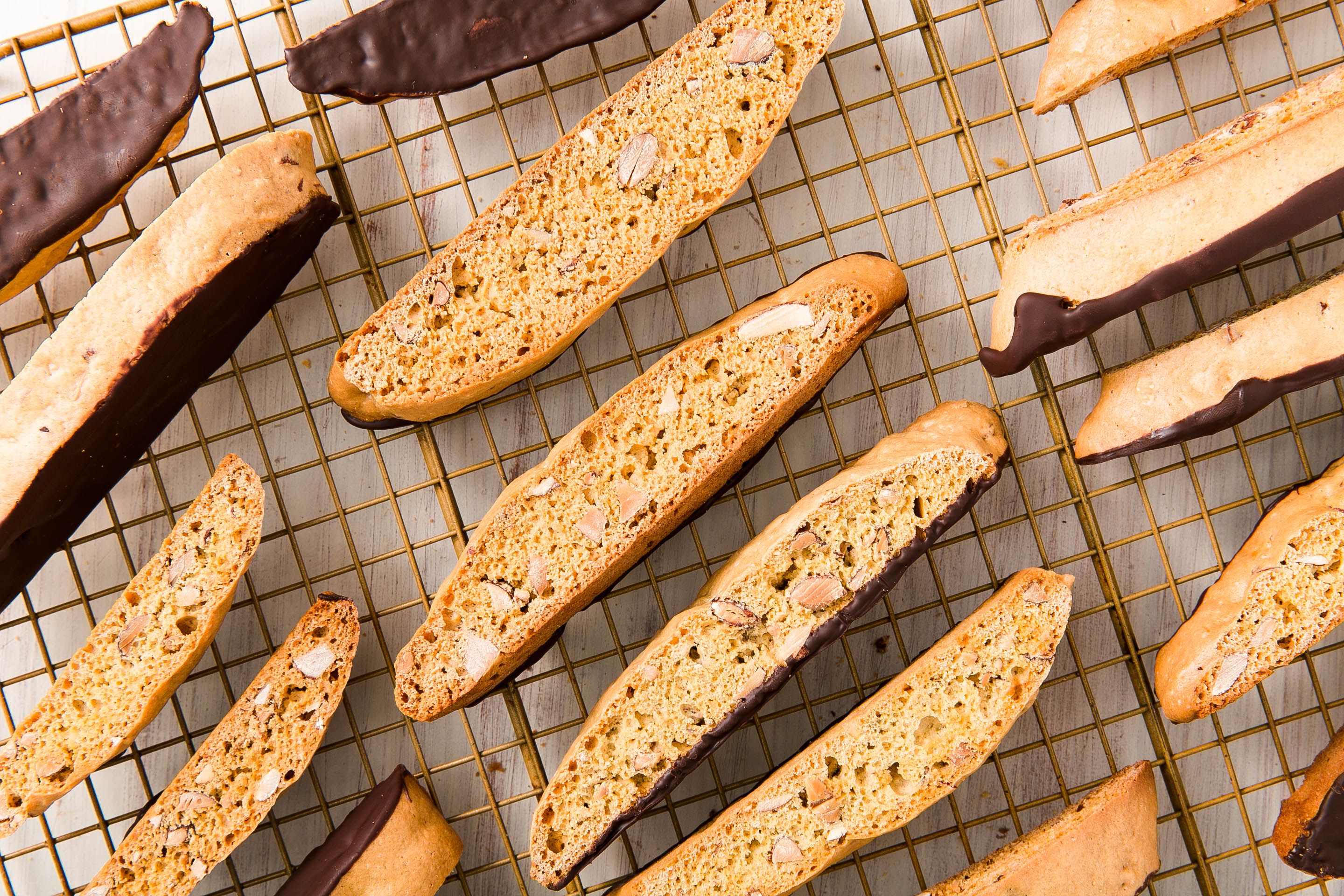
Traditional biscotti is a twice baked sweet bread, and though most cookies are not twice baked, the texture is similar so it’s understandable why the English would start calling them biscuits.
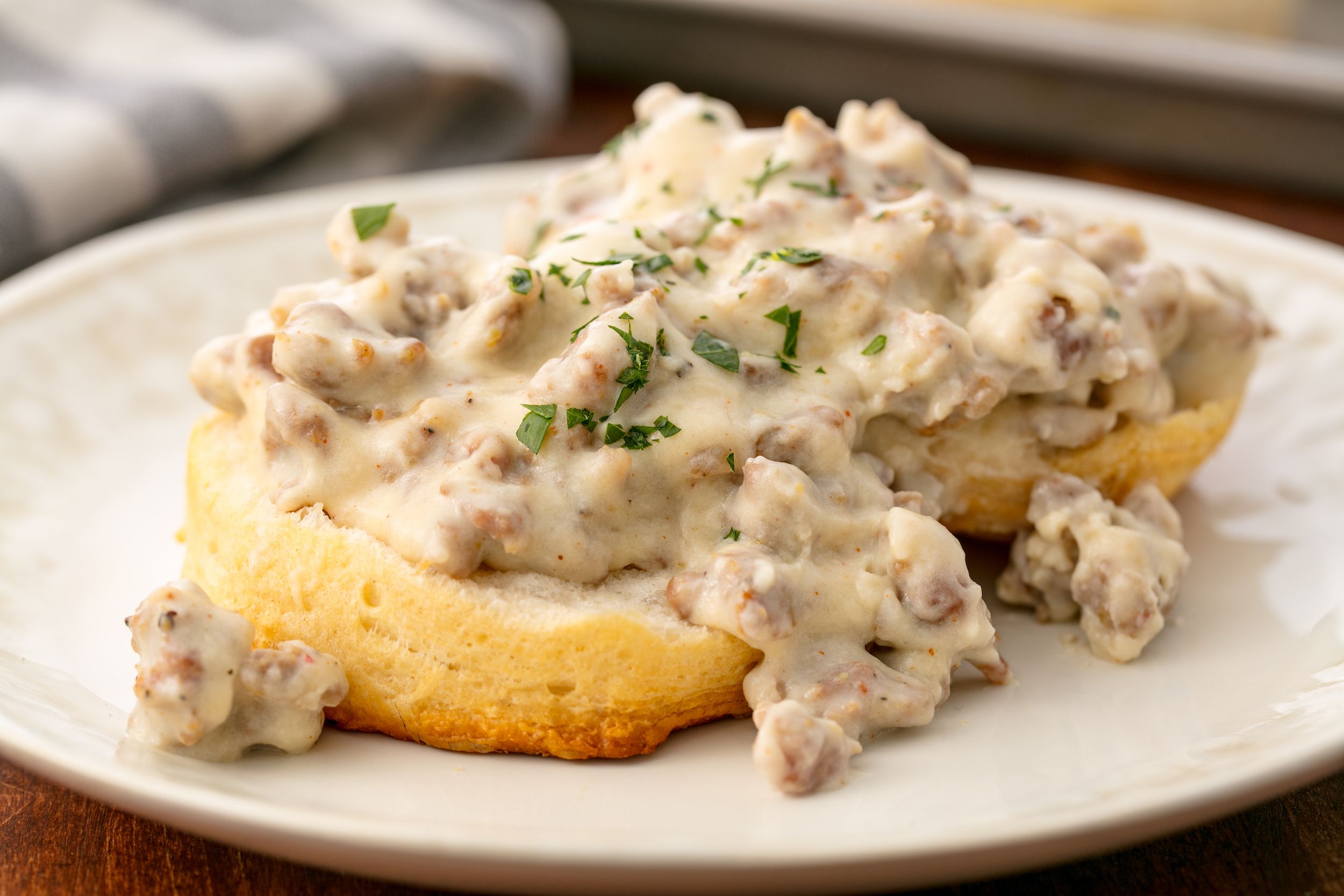
The first use of biscuit being used to for those awesome things you get with gravy in the south, was recorded in 1818 to describe the sort of food that sawmill workers were being served in Appalachia at the time. Those biscuits were probably pretty stodgy because baking powder and soda hadn’t been invented yet, so to give them some leavening they (meaning a kitchen slave) just beat the crap out of the dough until slavery was abolished and then a machine was invented to do it. These were served with gravy because pork fat was abundant and cheap. These biscuits were sort of a more nutritious and filling form of hardtack because they had lard added (fats are filling). The thinking around calling them biscuits is that it came with the Scottish colonists who settled in Appalachia. They called them “soft biscuits” in Scotland, and the name, much like biscuits and gravy, stuck.
My sister’s Instagram friend lives in the UK and he mentioned that, when visiting his brother, rather than staying in the main house, he slums it in the conservatory. Upon hearing this, my sister exclaimed, “Your brother has a CONSERVATORY!?!?” because here in The States, having such a thing makes one sound quite posh. This got me thinking about the different forms of this type of structure, and all the different words for them which vary by region and use.
When one says The Conservatory, it calls to mind visions of a glass room off the side of an old victorian mansion filled with gigantic tropical plans and a fainting couch, but apparently it’s just what we in the States would call a sunroom, or in New England, a three-season porch.
Classic Three Season Porch on the second floor of this house in Somerville, MA.
The classic three-season porch is a semi enclosed porch, usually off the back of each floor of a triple-decker apartment building. It’s usually got wood framed, generally uninsulated, solid walls which turn into window frames about halfway up which usually have both screens and glass storm windows. It’s so-named because in New England we have cold winters, so you can usually get about 3 seasons of use out of it. Lots of folks just use these as storage, or a place to hang your laundry to dry. You do sometimes see them on houses, but often these are more widely referred to as screened-in porch, or just screened porch. In Hawaii this is known as a lanai, or in Arizona and other parts of the southwest, the arizona room. There’s also the breezeway, which is a long, generally open-walled but always roofed structure which connects two structures.
Incidentally, the triple-decker is considered to have originated in Massachusetts and hundreds of thousands of them were built in and around New England between 1870 and 1920, particularly in rapidly industrializing areas where lots of people were working in mills and factories and needed housing.
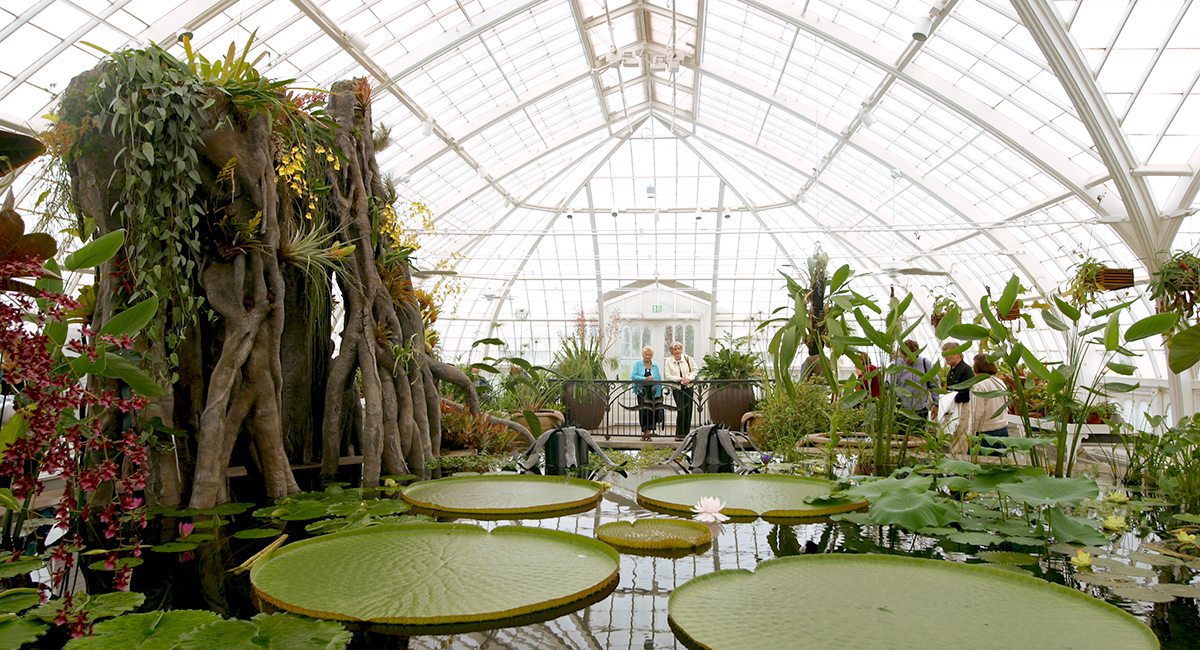
We also have something called a sunroom, which more closely resembles the classic idea of a conservatory or solarium in that it generally has large windows or a wall of windows, and often has a tiled floor. In the UK in order for a structure to be designated a conservatory it has to have “at least 50% of its side wall area glazed and at least 75% of its roof glazed with translucent materials, either polycarbonate sheeting or glass1.” The custom of conservatories dates back to Roman times when folks would bring their tender citrus plants inside during cold spells and place them into rooms called limonaia. In northern Europe, they were known as orangeries, and from there evolved into conservatories, so named because of their practical use for conserving plant life which would otherwise perish in the cold. Many of the beautiful, large and ornate Victorian era conservatories still exist in Europe and across the US as well. Some classic examples include the Conservatory of Flowers in San Francisco, CA and the Glasgow Botanical Garden in Scotland.
The habit of having a simple conservatory on one’s house came into fashion in the 1950s after more advanced glazing techniques were invented.
Weirdly, I actually have had a lot of conversations about what the actual definition of a porch is, vs a balcony or veranda. In our old apartment, which was a triple-decker, we had a back porch (which I miss very much), but it was on the second floor, and I’m not quite sure that counts as a porch or a balcony. It wasn’t screened in and had no windows. It wasn’t technically a veranda because those are always placed on the ground floor. I always went with back porch, but never really felt satisfied with the use of the word.
The word porch comes to English from Old French porche which got it from Latin porticus which specifically referred to a covered walk between columns, and itself was formed from an older word porta, meaning “gate, door, entrance.” Porta is likely from the PIE root *per- meaning “to lead or pass over.”
That etymology unfortunately doesn’t help me with my quest to find a better word for the structure that we so enjoyed at our old apartment, but I’m glad to have had the time to research it anyhow.
Got an unusual form of porch, conservatory, or sunroom where you’re from? Share in the comments below.
This morning I typed the word cavalry, and decided it was a weird word and needed to be looked up so here we are, the etymology of cavalry.
This is one of those words that comes to English from romance languages. Middle French, cavalerie, and Italian, cavalleria and cavalliere, meaning “mounted soldier.” It comes from the Vulgar Latin word for “horse,” caballus.
Side note 1: Old Latin called horses equus, which comes from an old PIE root ekwo-. You’ll recognize this root in words like equestrian, hippopotamus, hippocratic, and even the word alfalfa.
Side note 2: alfalfa has a very interesting history as a word. It comes to us from Spanish, but it came to Spanish from Arabic, and to Arabic from two Old Iranian root words, aspa- meaning “horse,” and -sti- meaning “food.”
Side note 3: the word horse, is a very old word and it’s unclear what its origin story is. Some people think it’s a loan-word from the Sarmatian language spoken by the Sarmatians of ancient Iran. They migrated northwest, eventually settling in the areas now known as Ukraine, Southern Russia and Poland. It’s one of those words that sounds the same in many languages, regardless of their roots, even in the Uralic languages like Finnish which are super weird and not really like anything else. The Finnish word for “horse or stallion” is varsa, which if you say it out loud, sounds a lot like “horse” spoken with a weird accent.
Ok back to cavalry. So the Vulgar Latin word was caballus, which is thought to have been a loan-word from some long dead Anatolian language, and originally it meant specificially, “work horse,” but it somehow caught on and became just the general word for “horse.” B sounds often morph into V sounds over time, so from caba you get cava and then cavalier, and then cavalry. Cavalier used to mean, “gallant, knightly, brave,” but then came to mean “easy, offhand and disdainful.” Funny how words do that. The surname Chevalier, and the word chivalry, come from this word.
From time to time, I will dive into certain PIE (Proto Indo European) roots. PIE is fascinating because it is essentially a reconstructed language that linguists uncovered within the languages spoken by Indo-Europeans today. Since it was likely to have been spoken in Neolithic times, no one has ever heard anyone speaking PIE, yet its roots can be heard every day. I have most certainly used a very large amount of PIE root words in writing this paragraph. Count them if you have an hour or two to spare and let me know what you find!
Today I’d like to talk about the PIE root eis, from which we get words like pediatrics, ire, hierophant, and so on. Shipley defines eis thusly, “set in quick motion ; wrath ; divine power.” In a way, this root imbues a word with a kick of that divine power. Take, for example, the word iron, from the German, eisen, meaning “holy metal.” Iron certainly changed our world, to the extent that an entire age of mankind is named after it, so it is no wonder that the ancient germanic people gave this substance a name that recalled for them the passion of wrath and divine power.
Or consider the way we name specialized medical fields, pediatrics, geriatrics. In these words you can find the Greek word iatros, which meant, “healer.” And where did the Greeks get iatros from? That’s right, the PIE root eis. It makes sense why, when you consider that in ancient times, the healing arts and spirituality were inseparably intertwined.
There are also those who think this root can be found in words like estrogen and estrus. Two words which represent the divine power possessed by the females of species to create life itself.
Pictured is an image from the Thoth Tarot deck of the trump card The Hierophant, from the Greek words hieros, meaning, “sacred,” and phainein, meaning, “to bring to light.” Thus, literally, “one who brings to light the sacred.”
Dialects and accents have always been fascinating to me, particularly since I grew up in a family where no one really spoke the same dialect as anyone else. My grandparents were both from somewhat posh areas on the outskirts of Boston, and spoke with what I can best describe as an old school Yankee accent. It was a bit more high brow sounding than the much-imitated accent of President Kennedy, for example, but had similar tones in it. My grandfather also adopted different accents for different ways of speaking. His reciting-something-from-a-book accent was very different from his every day speaking accent. My grandmother is from Winchester, and she’s always had a somewhat posh sounding Brahmin accent. More like the man on the right than the left in this video, but really a combo of the two:
My mother and her brothers all speak with a Massachusetts South Shore accent (some more than others). They all speak like the man in this video.
My aunts Mabel and Meg have different accents from their other siblings. This is due to Mabel having lived abroad in England for a time, and Meg having lived in the city for the vast majority of her life. It is hard for me to describe Meg’s accent because it has a lot of different sounds in it. Meg’s husband Jimmy, however, grew up in Somerville and he speaks exactly like Whitey Bulger does in the video below. My uncle Jimmy is a character and a half. (CW: Whitey is talking about some violent behavior in this video so consider yourselves warned.)
My father is from Kentucky, and his grandmother, Ida, spoke with a strong Appalachian accent, like the people in the video below (please watch this video, it is AMAZING). She passed when I was 14, but before that she would call me every year on my birthday and sing me Happy Birthday and at the end she would say “Jesus loves you, Emily.” in her sweet accent. I miss that. My father’s mother Ruth lived in southern Ohio longer than in Kentucky so she spoke with a stronger Midwestern accent than Appalachian. She said the word wash as worsh, for example. It makes me sad that I can barely remember her voice. She died when I was 7. My father speaks with a blend of those two accents, with hints of a Boston accent and a South Shore accent. It’s very unique and very endearing.
My sister, Abby, and I had so many different accents in our world as kids that we ended up having a bit of trouble saying L and R sounds correctly. I can still recall our family poking fun of us for how we said the word owl as owah, for example. Eventually we sort of gave up and unconsciously decided to speak like all the people on TV and in old movies. People are often surprised when they hear that I’m from the South Shore of MA since I don’t have a South Shore accent. On a recent trip abroad, everyone in Scandinavia thought that I was British, though I would not describe my accent as British at all. It’s also not a typical American accent either though. My sister and I actually speak differently from each other at this point in our lives. For a few years, Abby has been working with and around people who are 10-15 years younger than her and their accent has rubbed off on her (though this may be news to her). Millennials have developed their own dialect and accent. I’m sure you’re familiar with it, it’s not just vocal fry and up-speak. It sounds casual, flirty, fun, and completely lacks any trace of the regional dialect from where the speaker grew up. The R sounds are hard, the vowels sort of whine their way out, and I have noticed that with Millennials, particularly the younger ones, there is less of a gender binary separation between how people of different genders speak this dialect. Everyone tends to speak the same no matter their gender identity. Check out this video of Jonathan Van Ness (I love him and also kittens!) for a good example of this accent, though keep in mind that his is VERY pronounced.
What got me thinking about dialects and accents today is this video that my friend Patty posted by Voices of Color by Insider about linguistic profiling. We all unconsciously profile people when we hear them speak, and it can have some dramatic consequences. Do you change your voice when you speak on the phone?
What dialect do you speak? What accents did you grow up hearing? How did they influence how you speak today? Have you ever consciously worked to change your own accent? Does your accent change when you feel certain emotions?




 Word Nerd