Professor Plum in the Conservatory With the Lead Pipe

My sister’s Instagram friend lives in the UK and he mentioned that, when visiting his brother, rather than staying in the main house, he slums it in the conservatory. Upon hearing this, my sister exclaimed, “Your brother has a CONSERVATORY!?!?” because here in The States, having such a thing makes one sound quite posh. This got me thinking about the different forms of this type of structure, and all the different words for them which vary by region and use.

When one says The Conservatory, it calls to mind visions of a glass room off the side of an old victorian mansion filled with gigantic tropical plans and a fainting couch, but apparently it’s just what we in the States would call a sunroom, or in New England, a three-season porch.

7 Bartlett Street, Somerville MA Real Estate Listing | MLS# 72224497
Classic Three Season Porch on the second floor of this house in Somerville, MA.

The classic three-season porch is a semi enclosed porch, usually off the back of each floor of a triple-decker apartment building. It’s usually got wood framed, generally uninsulated, solid walls which turn into window frames about halfway up which usually have both screens and glass storm windows. It’s so-named because in New England we have cold winters, so you can usually get about 3 seasons of use out of it. Lots of folks just use these as storage, or a place to hang your laundry to dry. You do sometimes see them on houses, but often these are more widely referred to as screened-in porch, or just screened porch. In Hawaii this is known as a lanai, or in Arizona and other parts of the southwest, the arizona room. There’s also the breezeway, which is a long, generally open-walled but always roofed structure which connects two structures.

Incidentally, the triple-decker is considered to have originated in Massachusetts and hundreds of thousands of them were built in and around New England between 1870 and 1920, particularly in rapidly industrializing areas where lots of people were working in mills and factories and needed housing.

Anatomy of a Three-Decker (or Triple-Decker, If You Prefer)

We also have something called a sunroom, which more closely resembles the classic idea of a conservatory or solarium in that it generally has large windows or a wall of windows, and often has a tiled floor. In the UK in order for a structure to be designated a conservatory it has to have “at least 50% of its side wall area glazed and at least 75% of its roof glazed with translucent materials, either polycarbonate sheeting or glass1.” The custom of conservatories dates back to Roman times when folks would bring their tender citrus plants inside during cold spells and place them into rooms called limonaia. In northern Europe, they were known as orangeries, and from there evolved into conservatories, so named because of their practical use for conserving plant life which would otherwise perish in the cold. Many of the beautiful, large and ornate Victorian era conservatories still exist in Europe and across the US as well. Some classic examples include the Conservatory of Flowers in San Francisco, CA and the Glasgow Botanical Garden in Scotland.
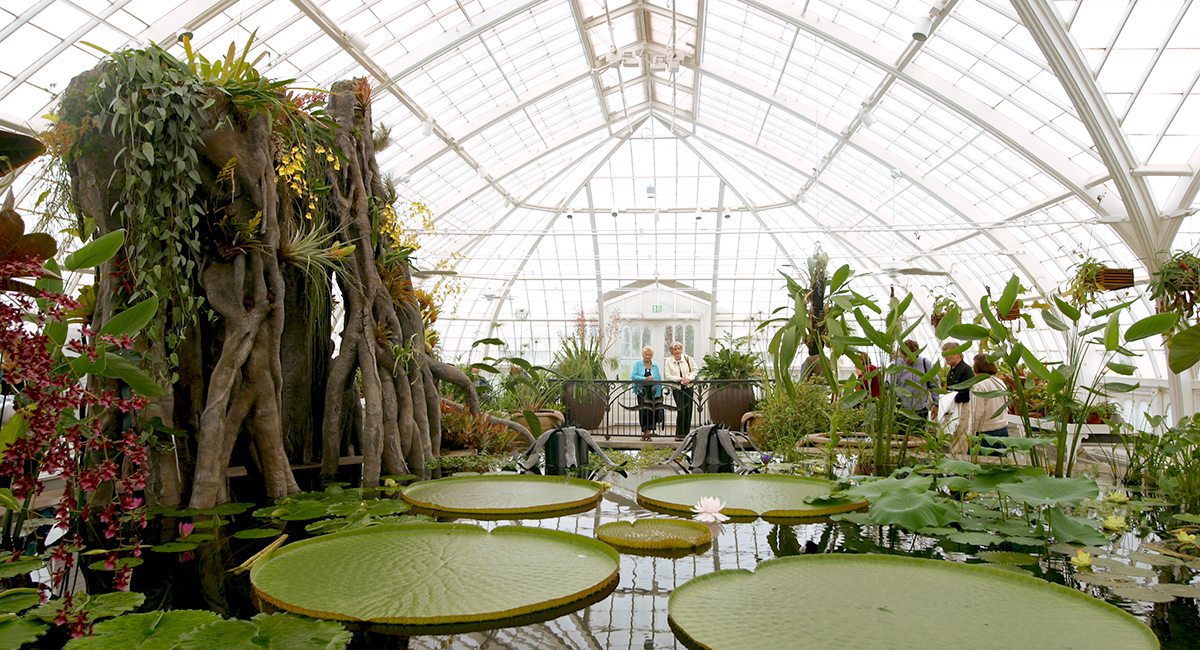
Lipstick, Fanged Pitcher, Flying Goldfish, Cobra, Lillipop…Say What?! | MIG

The habit of having a simple conservatory on one’s house came into fashion in the 1950s after more advanced glazing techniques were invented.

Weirdly, I actually have had a lot of conversations about what the actual definition of a porch is, vs a balcony or veranda. In our old apartment, which was a triple-decker, we had a back porch (which I miss very much), but it was on the second floor, and I’m not quite sure that counts as a porch or a balcony. It wasn’t screened in and had no windows. It wasn’t technically a veranda because those are always placed on the ground floor. I always went with back porch, but never really felt satisfied with the use of the word.

The word porch comes to English from Old French porche which got it from Latin porticus which specifically referred to a covered walk between columns, and itself was formed from an older word porta, meaning “gate, door, entrance.” Porta is likely from the PIE root *per- meaning “to lead or pass over.”

That etymology unfortunately doesn’t help me with my quest to find a better word for the structure that we so enjoyed at our old apartment, but I’m glad to have had the time to research it anyhow.

Got an unusual form of porch, conservatory, or sunroom where you’re from? Share in the comments below.

1 Source: https://en.wikipedia.org/wiki/Conservatory_(greenhouse)

No

Etymology: No

Nope GIF - Nope Duck NoWay - Discover & Share GIFs | Funny gif, Funny  pictures, Animals

Every language has a word for it. Some have many. Let’s explore the etymology of no.

In English the word no dates back to Middle English and means “not in any degree, not at all, not ever.” Though it’s a short word with only two letters, it’s actually formed from two elements, the first being the PIE (proto indo european) root *ne- meaning “not,” and the second from the PIE root *aiw-, meaning “vital force, life, long life, eternity.” In fact, the root *aiw- is where we get the word ever from, as well as the words eon, eternal, age, and the Old Norse word ævi, meaning “lifetime.” Thus the word no literally means, “not ever.” I love this etymology because it shows the powerful refusal that no implies. It says, “not now, not ever, not for my entire life, not for all eternity.”

Another formally popular refusal word in English is nay, which comes to English from the Old Norse word nei, but Old Norse got nei from the same PIE roots as no, so they’re basically the same word but nay sounds more like the original pronunciation.

Many other languages use a similar sounding word to say “no” and those words all have the same etymology. In French it’s, non. In Italian, Spanish, and Nepalese, no. In Portuguese, nāo. In Russian and Serbian, net. In Polish, nie. In German, nein. In Bosnian, Croatian, Czech, and Latvian, it’s ne. In Ukranian, ni. In Danish and Swedish, nej. In Icelandic and Norwegian, nei. In Persian, næh. In Hindi, nahin. In Punjabi, nahīṁ. In Bengali, . In Latin, nihil. In Irish, níl.

Then Greek comes along and is like, how about we make our word for “yes” be nai just to confuse the rest of Europe! Their word for “no” is ochi, which actually has the same PIE root *ne- that no uses, but rather than combining it with *aiw-, it was combined with *ko which is a root that’s used to form words having to do with pointing out things, for example, who, what, him, her, that sort of thing.

In the Maori language, the word for “no” is kāo, or kāore. This word is also used when making grand statements about things, for example, “How great is my anger!”

In Welsh, the word is either ni, nid (for vowels) or dim, and it is entirely context related which one is used. It’s one of those “fun” linguistic curiosities where you really have to be a native speaker to understand when to use dim vs ni/nid and using one instead of the other would sound really weird, but it’s tough to explain why to a non-native speaker. In Middle Welsh, dim meant “anything,” but it became common to use it to reinforce negative statements like, “she was anything but frail.” So it wound up as an additional way to say “no.”

When did you last use the powerful word NO in your life? Did it make you feel empowered or did it make you feel bad? How do you say “no” in the languages you speak? I’d love to learn more about the etymology of words in more non-European languages. It’s often a challenge to investigate etymology in languages I’m not familiar with. Translations are possible, but diving into the construction and history of words isn’t easy for a non-native speaker. My curious mind often calls me to try though!

Centenarian

Etymology: centenarian

Today, my dear sweet grandma is 100 years old!  Although I credit my grandfather for my love of words, anything that’s practical, skillful, witty or quietly nourishing about me I owe to my amazing grandma Betty.  Due to quarantine rules, we are unable to celebrate this momentous day with her in person, so we’ll settle for a family Zoom video call. She’s currently dealing with a positive diagnosis for COVID-19, but is blessedly asymptomatic and her doctors are optimistic that she will stay that way. Still, we welcome any good thoughts to be sent her way!

95608247_10156902560182085_3750188335595782144_n

Though she will likely shy away from any acknowledgement of this achievement in her usual mildly self-deprecating way, it’s obviously quite a big deal to those of us who love her. She is now a centenarian! Has a nice distinguished ring to it doesn’t it?  The first recorded use of the word was in 1805.  Prior to that, people used the word centenary either as an adjective to describe things related to or consisting of 100 years, or as a noun to describe a period of 100 years or the celebration of a hundredth anniversary.  This word is still used in British English, but in America we tend to use the word centennial.

Both centenary and centenarian come from Latin centenarius, which formed from the word centum, meaning “hundred.”

As an aside, the English word hundred comes from a Proto-Germanic word, *hundam.  The Proto Indo European root for both centum and hundam is the word, *dekm-, which actually means 10.  This PIE root gives us a clue as to how the somewhat different sounding words centum and hundam happened. There’s this thing in spoken language where consonant sounds evolve over time, often due to people skipping or combining sounds to speed up speech. There are lots of different ways and reasons why this happens.  (Here’s a good wikipedia article about it for those interested.) Basically people added some suffixes to *dekm- to multiply it for use as the number 100.  Latin ended up with the one that sounded more like satam or centum, and Proto-Germanic ended up with the one that sounded more like hundam.  Language is weird.

Anyhow, I’m happy to be celebrating my favorite centenarian today. 100 years of Betty is never really enough, but I’ll take it. Here’s to 100 more!

Fever

Etymology: fever

hqdefault

This word comes from Old English fefor, or fefer, which is from the Latin febris and is related to another Latin word fovere meaning “to warm, or heat.”  There is some debate on the origin of febris or foever.  Some linguists think it’s from the PIE root dhegh-, meaning “burn.”  Others speculate it comes from an old Sanskrit word element bhur-, meaning “to be restless.”

Plague

Etymology: plague

blackdeath_main

From Old French plage, via Latin plaga meaning “wound,” and plangere, meaning, “to strike, or lament.”  Or from the Greek, plaga, meaning, “blow,” as in a hit or strike.  All of these words come from the PIE root plak- (2), meaning “to strike.”  You’ll find this root in words like plankton, complain, and apoplexy.  The word plague came into use in English in the 1540s as a term for a pestilence with many casualties after the bubonic plague began to scourge Europe.

Vaccine

Etymology: vaccine

Edward Jenner[3604]

Believe it or not, this word actually relates to cows!  Don’t worry, I’ll explain.  The Latin name for the cowpox virus is variolae vaccinae, which comes from Latin, vaccinus, meaning, “from or pertaining to cows.”  The word vacca, in Latin, means “cow” and no one is sure of its origin.  Incidentally, the English word cow is a very old word dating back to the PIE root gwou- and is pretty much the same in all Germanic languages.  Anyway back to vaccine!  Smallpox was a very big problem for humans prior to around 1800.  It was observed that milkmaids, due to having been exposed to a similar but much less deadly infection called cowpox, had developed an immunity to smallpox. British physician Edward Jenner accidentally invented the vaccine by injecting people with the cowpox virus, or vaccinae, making them immune to smallpox as well.

The word wasn’t used in reference to other diseases until Louis Pasteur, inventor of the rabies vaccine, started doing so.  Incidentally, Pasteur also invented pasteurization, and thus the word pasteurize is simply Pasteur’s surname with -ize added to it.  His surname is French and means, “pastor.”

Speaking of Louis Pasteur, when I was a kid, I remember seeing a video, or maybe it was just a book, where Louis Pasteur is explaining what a vaccine is to a young boy.  I remember he said that it’s like a bunch of soldiers are marching into your body to protect you from diseases.  I have been unable to track down this book or video, so if anyone else remembers this and can shed some light on it, that’d be awesome!

Virus

Etymology: virus

200130165125-corona-virus-cdc-image-exlarge-tease

First recorded in English in the late 14th century, this word comes to us from the Latin, virus, meaning, “poison, sap of plants, slimy liquid, a potent juice,” from Proto-Italic weis-o-(s-) meaning, “poison,” itself likely from the PIE root ueis-, meaning “slime, rot, strong smell, poison.”  You can find the root ueis- in words like viscous and viscosity.

Its use as a noun to describe something that causes infectious disease was first used in 1728.  Louis Pasteur, famous for his breakthroughs in the creation of the rabies vaccine, speculated that viruses existed, but the observation of a virus by microscope wouldn’t happen until 36 years after his death, when the electron microscope was invented in 1931.

Corona

Etymology: corona

158012206277617

First recorded in the 1650s, from Latin, corona, meaning, “crown,” from Ancient Greek, korōnè, meaning, “garland, wreath.”  In ancient Rome this word specifically referred to a type of garland or crown given to people who performed admirably in military service. The word comes from a PIE root sker- (2) or ker-, which means “to turn, or bend.”  You’ll recognize this root in words like circle, circumference, and also in words like range, ridge, and ring.

In many European and Scandinavian countries, currency is often referred to as crowns, or kroner due to the habit of imprinting the current monarch on the coins.

The circle of light seen around the sun during a total solar eclipse is also called the corona, and was named in 1890 by Spanish Basque astronomer José Joaquín de Ferrer.

Cavalry

Etymology: cavalry

This morning I typed the word cavalry, and decided it was a weird word and needed to be looked up so here we are, the etymology of cavalry.

This is one of those words that comes to English from romance languages.  Middle French, cavalerie, and Italian, cavalleria and cavalliere, meaning “mounted soldier.”  It comes from the Vulgar Latin word for “horse,” caballus.

Side note 1: Old Latin called horses equus, which comes from an old PIE root ekwo-.  You’ll recognize this root in words like equestrian, hippopotamus, hippocratic, and even the word alfalfa.

Side note 2: alfalfa has a very interesting history as a word.  It comes to us from Spanish, but it came to Spanish from Arabic, and to Arabic from two Old Iranian root words, aspa- meaning “horse,” and -sti- meaning “food.”

Side note 3: the word horse, is a very old word and it’s unclear what its origin story is.  Some people think it’s a loan-word from the Sarmatian language spoken by the Sarmatians of ancient Iran.  They migrated northwest, eventually settling in the areas now known as Ukraine, Southern Russia and Poland.  It’s one of those words that sounds the same in many languages, regardless of their roots, even in the Uralic languages like Finnish which are super weird and not really like anything else.  The Finnish word for “horse or stallion” is varsa, which if you say it out loud, sounds a lot like “horse” spoken with a weird accent.

Ok back to cavalry.  So the Vulgar Latin word was caballus, which is thought to have been a loan-word from some long dead Anatolian language, and originally it meant specificially, “work horse,” but it somehow caught on and became just the general word for “horse.”  B sounds often morph into V sounds over time, so from caba you get cava and then cavalier, and then cavalryCavalier used to mean, “gallant, knightly, brave,” but then came to mean “easy, offhand and disdainful.”  Funny how words do that.  The surname Chevalier, and the word chivalry, come from this word.

69107844_10156187416522085_8638540500665630720_n


Creature

Etymology Lesson: creature

The other day I was thinking about the word creature and that got me thinking about the word creator, so here is an etymology lesson for those.

Both words have the same PIE root, in Shipley’s it’s ker-(VI), which itself means “to grow,” and informs words like, crescent, increase, procreate, recruit, and accrue, and the name of the Roman goddess of agriculture, Ceres. (pictured)

eb94697a1a57f04243f23b23c3c3691c

Side note: my dear friend Sarah named one of her feline companions Ceres, only to find out later that Ceres was a boy, (R.I.P. Ceres! You were a big fluffy dummy and we miss you!)

For creator, ker-(VI) combines with the latin suffix -ator, which is basically the noun form of a verb that ends in -ate, in this case, create. (I think?  Latin suffixes perplex me, so maybe someone who has studied Latin can school me?) So, creator means “one who causes things to grow,” and creature means, “a thing that has been grown.”

The PIE ker- root variations are pretty vast, Shipley’s has seven distinct ones, with meanings like, “to turn,” “to burn,” “to scratch or cut,” “of or related to having horns,” “to cry out,” “to grow,” and “to destroy.”  It reminds me that PIE is at best a well-researched theory, but I suppose everything is.